
The result of high levels of hype about new technologies is that people start to think that:
- The world has just been changed forever (which sometimes, but rarely, is true to some extent).
- The new technology that is being hyped will continue to change the world in powerful and unimaginable ways.
- The new technology is a once in a lifetime, or even once in a millennium, singular event.
[[I think it is no coincidence that these three thoughts are similar to those that found new religions or cults. But my argument below is independent of that correlation.]]
The topic of this post is the following koan applied to new technologies. It is two very general truths that people who think they are powerful ignore at their own peril. As with all koans the principal goal here is to remind people to be humble.
Things work until they don’t.
Things don’t work until they do.
Things work until they don’t. For the first sentence of the koan, let’s think back to a technology which had profound influence on the world, where people could live, where they could farm, and with whom they could trade. It completely transformed the world.
Here is a brief history of steam power, which was first used at scale in 1712, but for a pretty boring task, pumping seeping water out of coal mines. It did, however, make it easier to get more coal, which was burned to power the steam pumps, and as general heating for houses, for cooking, and for processing metals.
Over fifty years later an innovation for steam engines made them much much more efficient, and now they could provide general purpose power to rotating mechanisms, replace horses that plodded around in circles to provide power for grinding, and invalidate the need to situate a weaving factory next to a fast flowing river.
This changed where the means of production could be located, and is known as the industrial revolution. More innovations happened and by the time steam boats were practical for rivers and steam locomotives were practical for trains it completely altered our landscapes. Farming could move west across North America and still have a way to sell the produce hundreds of miles away on the east coast. Networks for trade grew across Europe and Asia, and eventually to other parts of the world.
Then a few years later, around 1838, steam engines got efficient enough that they could carry enough coal to power themselves all the way across an ocean and additionally carry enough cargo to make a profit through trade.
Another fifty years on, in 1884, the steam turbine was developed and that allowed electricity generation, which meant that now the coal could be burned in one place and provide power in different places, over wide areas. Steam turbines are still how we generate electricity from coal, gas, and fission nuclear reactors. It will be how we generate electricity when fusion power finally becomes practical, which is looking more and more likely to happen in the next ten to twenty years. Steam is still a key technology enabling our current civilization.
Steam was the magic technology that transformed the world again and again for around two hundred years.
But then it wasn’t the driving force for new innovations any more. Steam powered automobiles appeared at the same time as electric powered and gasoline powered automobiles appeared. Both steam and electricity lost that competition, though recently electric powered cars are making a real dent in the gasoline automobile market.
That was steam’s last hurrah. It just wasn’t the right technology for airplanes or rockets.
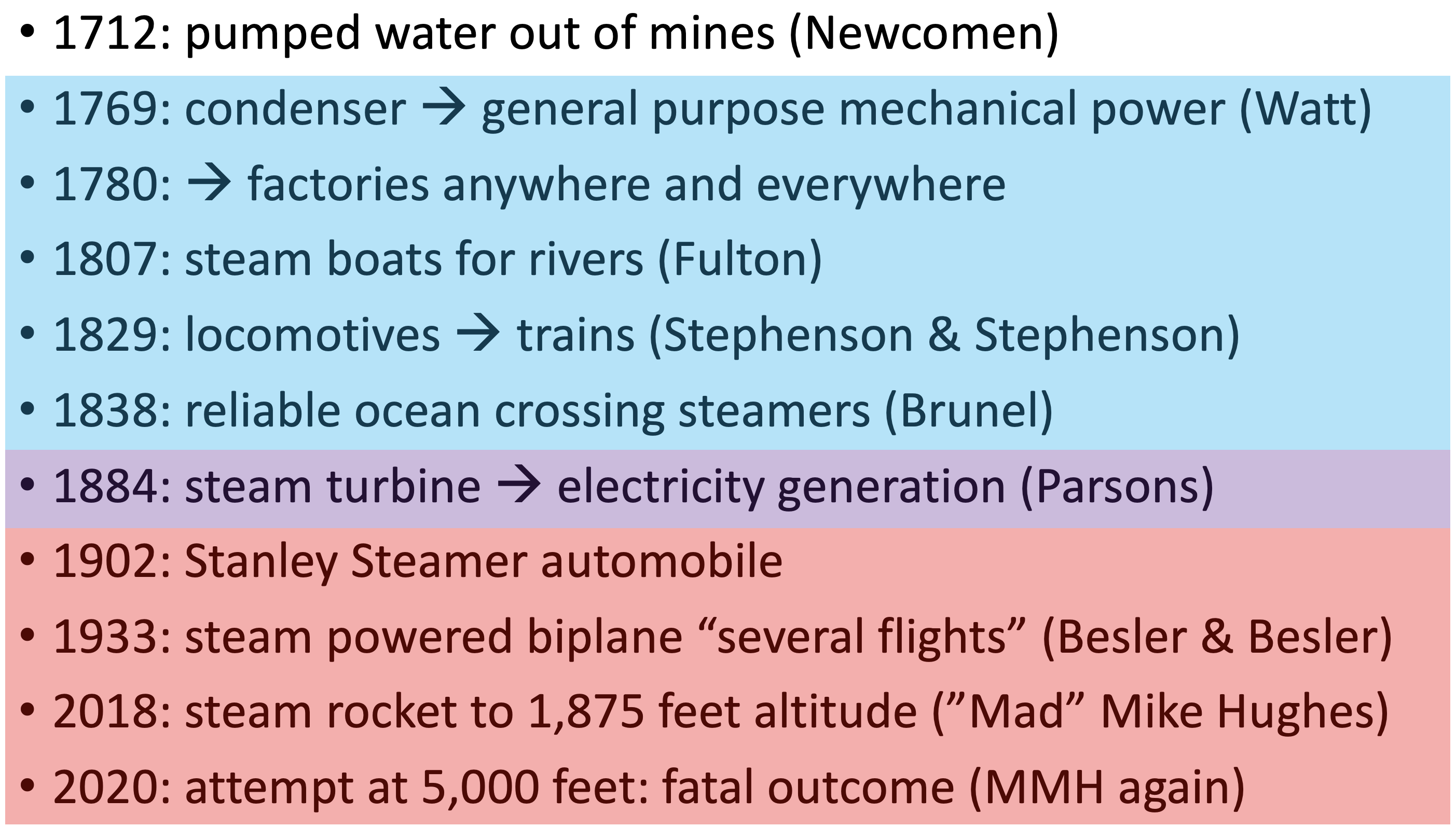
Steam ran out of steam around the year 1900. It is still with us and will continue to be important in our world, but despite 200 years of dominance it was no longer the best solution to new problems.
Steam worked, as a go to technology solution for producing mechanical work across new domains, until it didn’t.
My point?
After an 80 year history of development of learning methods we see machine learning based on neural networks and reinforcement learning having tremendous success after success.
But that does not mean that those two machine learning technologies will forever be what we need to make progress in technology and science with Artificial Intelligence driving the way. Perhaps different learning methods will be needed. Perhaps something different than machine learning will be needed.
Current machine learning techniques may run out of steam. When? We do not know. How far can they go? We do not know.
What we do know is that all past technologies have eventually been supplanted by new ones–just as all past science has eventually been supplanted by new science.
The lesson to keep in mind is that we can never, in advance, bet that a currently winning technology will be able to solve all the problems that pop up. We will need new technologies, and so it behooves us to be working on successors to current winners even now.
Why now? Can’t we just develop the new ones when we need them?
And that is the second part of my koan.
Things don’t work until they do. More generally, all new technologies take decades of sustained efforts to be made practical, just as steam power had a fifty seven year run before the idea of a condensor, separate from the drive piston, was needed to get it to the next level.
All technologies? Decades? Can that be true?
Let’s take a look at the history of the two learning technologies powering our current revolution. Let’s look at the history of both neural networks and reinforcement learning.
Both of them arrived in essentially their current form of approach over sixty years ago, and both of them were declared dead again and again, since then. And then they weren’t dead, but instead deadly important.
I have Appendix II at the end of this post which shows the state of both neural networks and reinforcement learning in the very early 1960’s. Both are recognizable as being the kernel of the current techniques still used today.
But each of these technologies took over fifty years of further development before they really burst on the scene as important.
Eventually, the people who pushed them to the point that they each revolutionized Artificial Intelligence were rewarded with the Turing Award.
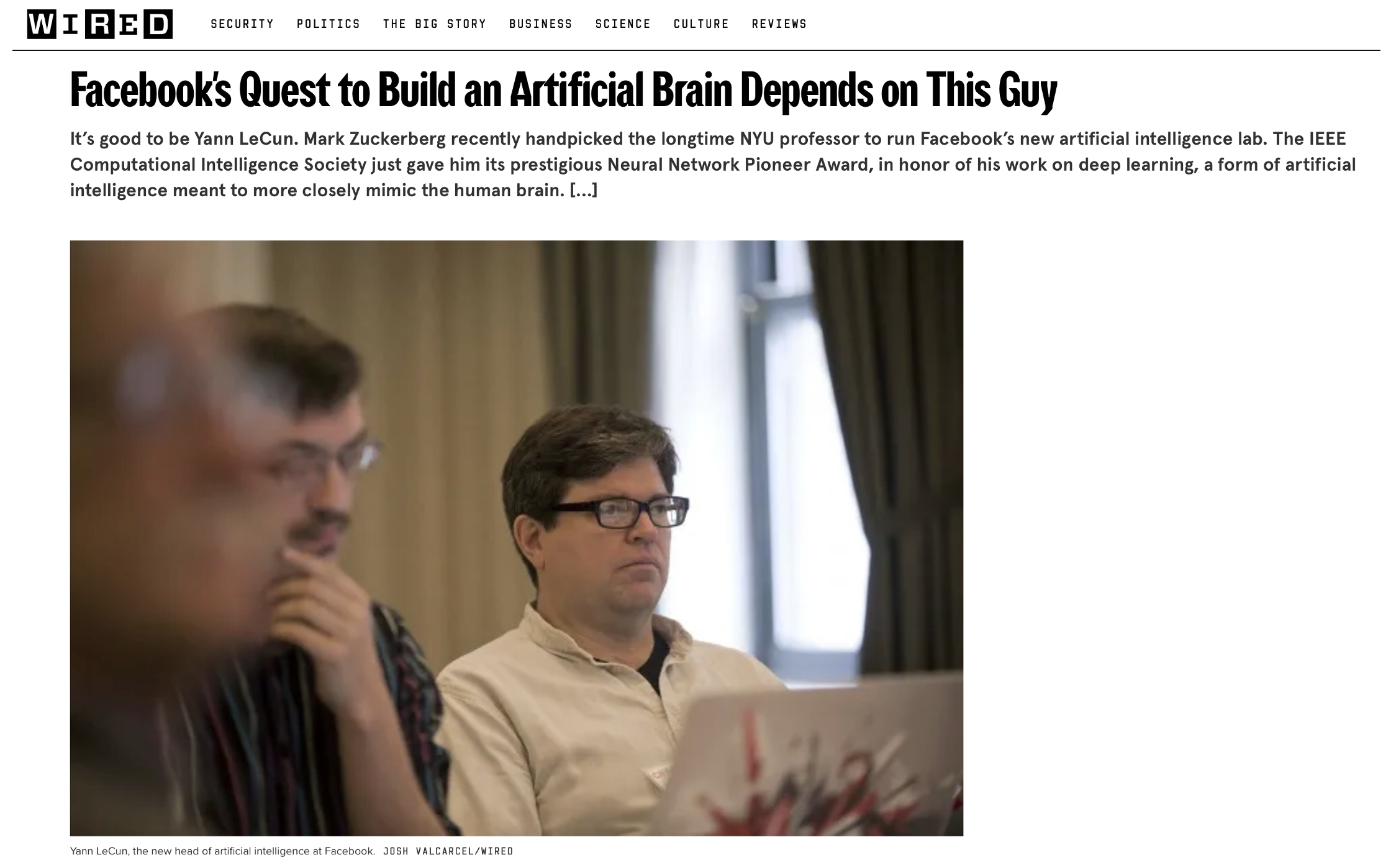
Yoshua Bengio, Geoffrey Hinton, and Yann LeCun won the ACM A. M. Turing Award for 2018. “For conceptual and engineering breakthroughs that have made deep neural networks a critical component of computing.”
Andrew G. Barto and Richard S. Sutton won the ACM A. M. Turing Award for 2024. “For developing the conceptual and algorithmic foundations of reinforcement learning.”
Eventually there was great success but both teams had for years felt they were on the outside and at the margins. See Appendix I below.
And this is how all great and important ideas and technologies develop. They come in fits and starts with moderate successes and then often large failures. It is only because a few people truly believe in them that they push hard enough so that eventually we all see that they were right.
Why not look for people who are working on ideas that are at the margins and crown them earlier, speeding up the development process. The problem is that in the long run most such people are wrong. Governments fund lots of research knowing that a vanishingly small portion of the ideas funded will be at the core of truly important technologies. That requires patience and accepting that there are many dead-end paths at the forefront edges of current human understanding.
Traditionally VCs have waited until they see that technologies have proven themselves in a particular application area, and then pour money on the new technology to hasten its acceptance.
Now surely no one would ever do this, but suppose VCs were given a role in determining government spending on research, rather than letting scientists and academics determine how to distribute the money (which is the traditional way it has been done). They would snuff out all the ideas like neural networks and reinforcement learning when they were only forty years into their journey. And then we would be stuck with rule-based expert systems as the peak of AI forever going forward.
No one would ever do that, would they?
Surely rationality would prevail and serious people would know that things don’t work until they do, and we need to be simultaneously exploring many ideas, even if most of them have only a small cohort of true believers.
Appendix I. Stories from the wilderness.
Here is a story from Wired in 2014 about Yann LeCun when he was at Facebook.
And here is a paragraph from that story, with my highlights:
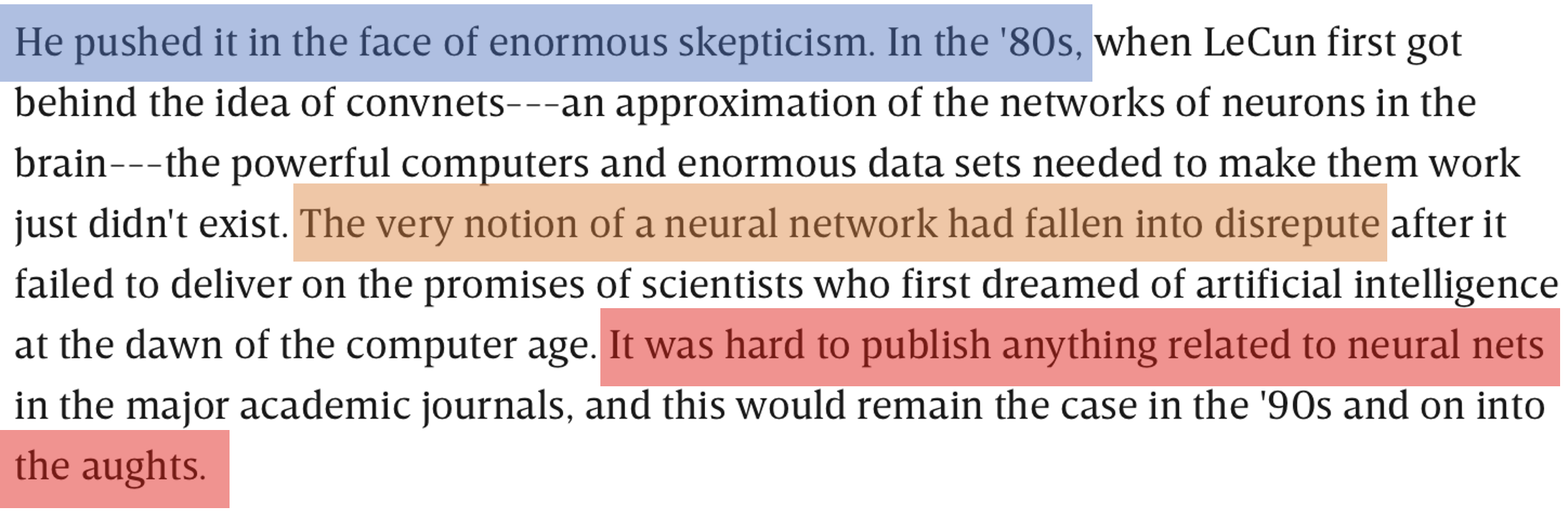
You can see, and we all knew, that LeCun (same is true of his Turing co-winners) felt like he was marginalized while working on a problem for decades. Then it started to work, and everything changed.
Likewise here is a story about Andrew Barto, this one from the Boston Globe in 2025, after his Turing Award was announced.
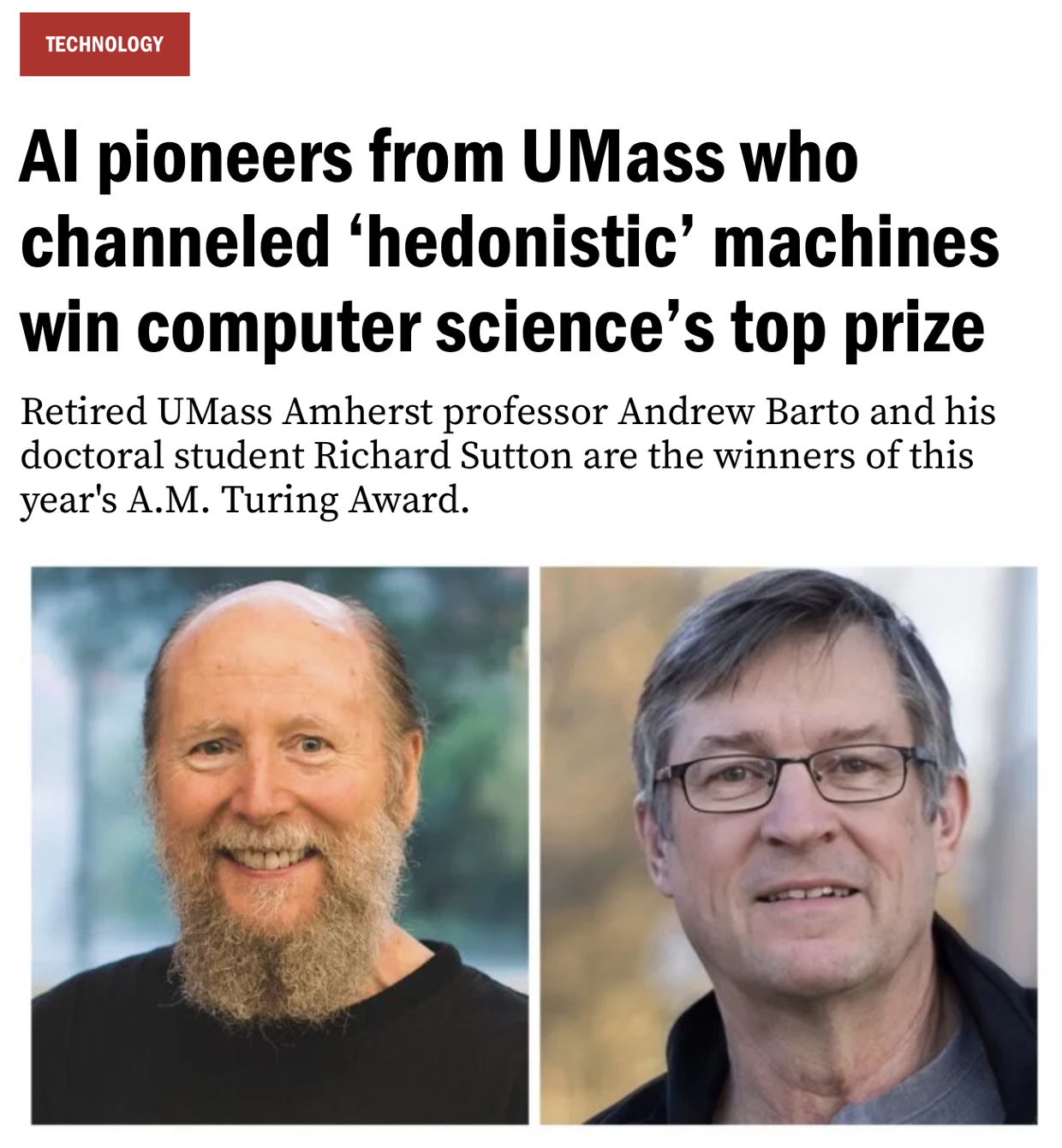
And again, I have highlighted comments about how things felt in their decades of getting the idea to really work.
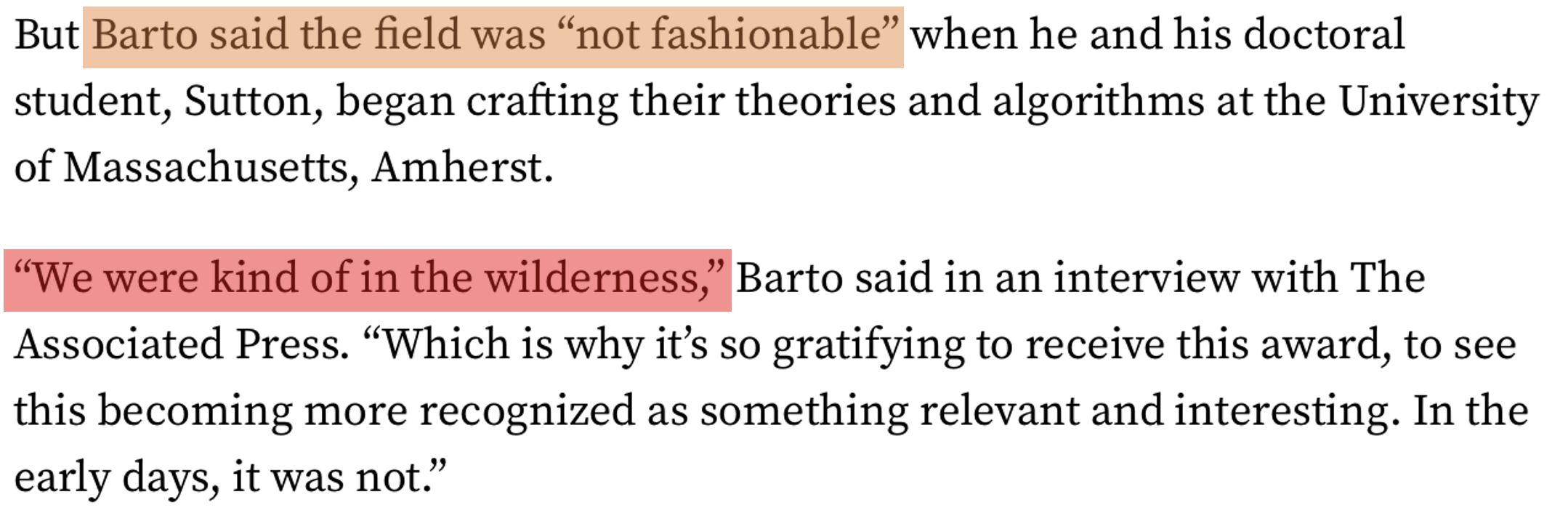
Appendix II. Foundation histories of two modern AI technologies.
Neural Networks
We can date the first attempt at a digital model of a neuron in a nervous to that of Warren McCulloch and Walter Pitts at the University of Chicago in 1943, A Logical Calculus of the Ideas Immanent in Nervous Activity. There they modeled networks of biological neurons as clock logical gates, such as OR, AND, etc. (Much later in 1959 when at MIT they worked with real biological systems and along with Jerome Lettvin and Humberto Maturana published the first paper on functional neuroscience: What the Frog’s Eye Tells the Frog’s Brain.)
Meanwhile Marvin Minsky wrote his Princeton Ph.D. thesis on neural networks (Minsky was one of the four authors of the proposal for the 1956 workshop on Artificial Intelligence at Dartmouth), and Frank Rosenblatt at Cornell developed models of two different classes of neurons that used weights to model synaptic variations, believed to be the locus of learning in the brain. Both Minsky and Rosenblatt explored analog mechanisms to model learning.
By 1960, Bernard Widrow at Stanford, had come up with a model of the neuron that we can recognize as essentially the same neuron model that is used in today’s neural networks, even though his were still implemented in analog hardware. This image is taken directly from a 1960 report by Widrow.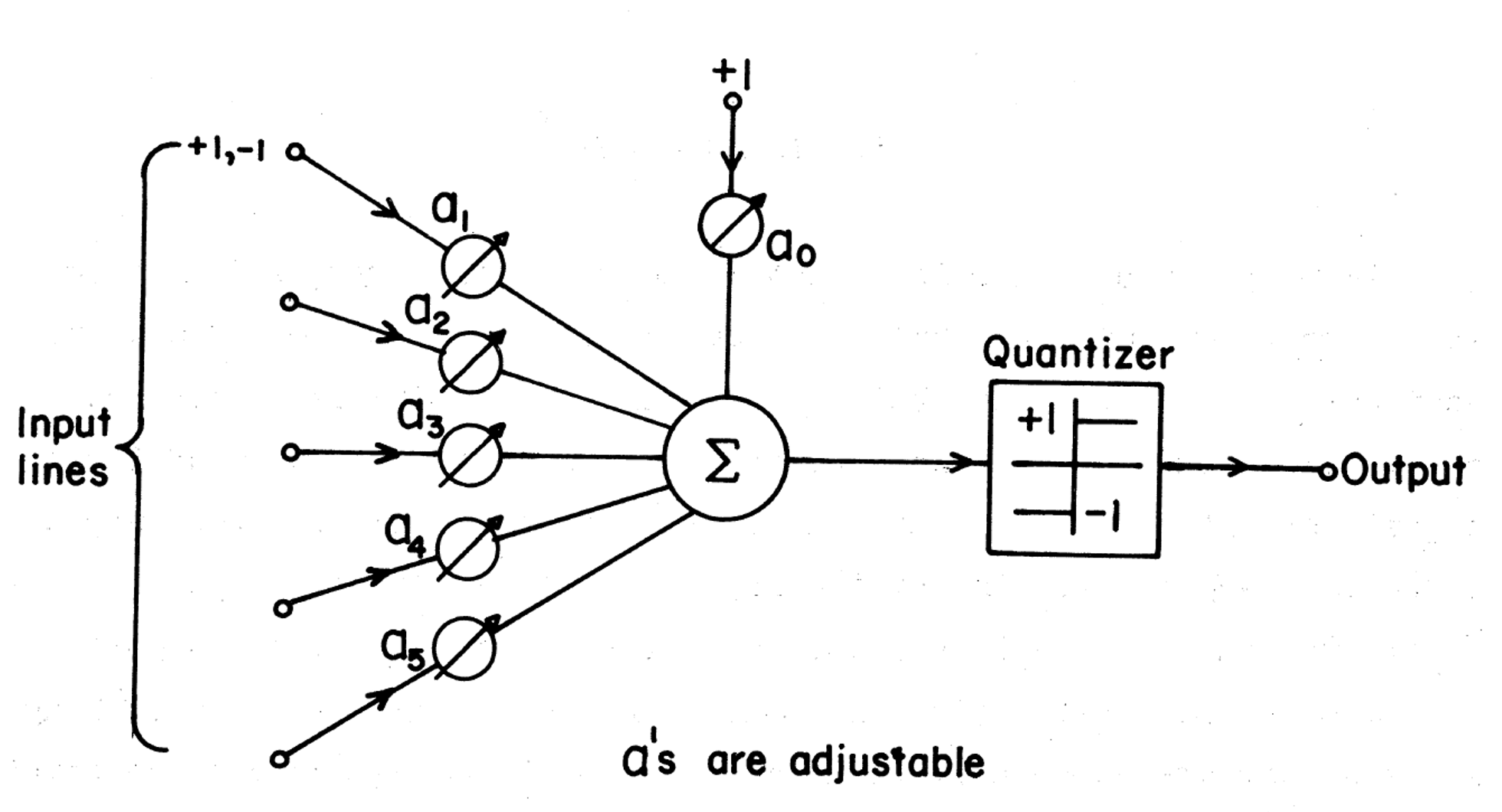
A year later, in 1961, he was starting to have a model for how to automatically adjust the weights swith o that the neuron (which he called an Adaline) could learn.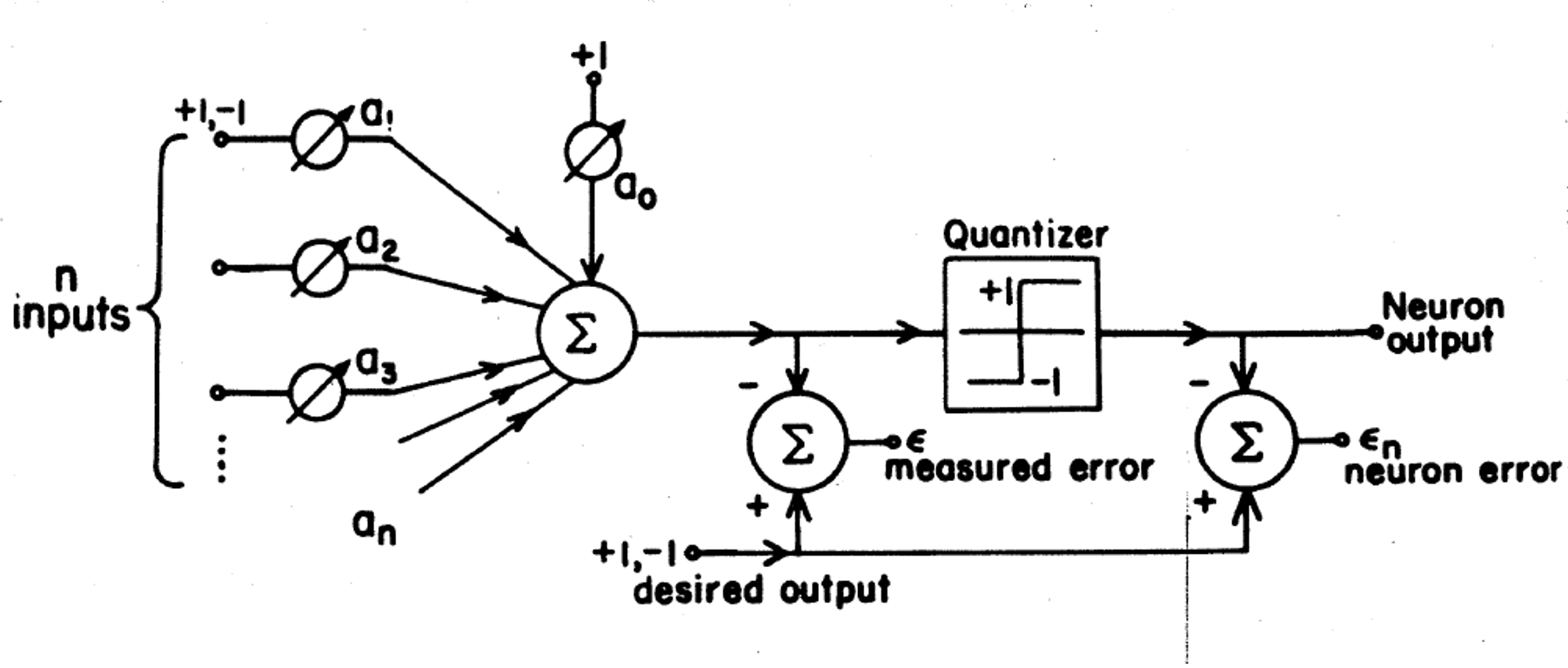
During the sixties Minsky and others explored a digital version of these neurons, calling them a Perceptron, following Rosenblatt’s name for his neurons, along with a digital algorithm to make them learn. But they found that a single neuron could only learn a limited class of things, and soon abandoned their approach.
Deep Learning multi layer networks of neurons that look just like Widrow’s from 1960, above, and variations on his learning model, with important developments like back propagation and convolutional networks, broke onto the scene in 2012, interpreting images better than traditional AI computer vision, and AI has not been the same since. That was a fifty year journey.
Reinforcement Learning
Donald Michie had been a colleague of Alan Turing at Bletchley Park working on code breaking during the second World War. He later took degrees in mammalian genetics, but during the 1960s he became one of the leaders of AI research in Great Britain.
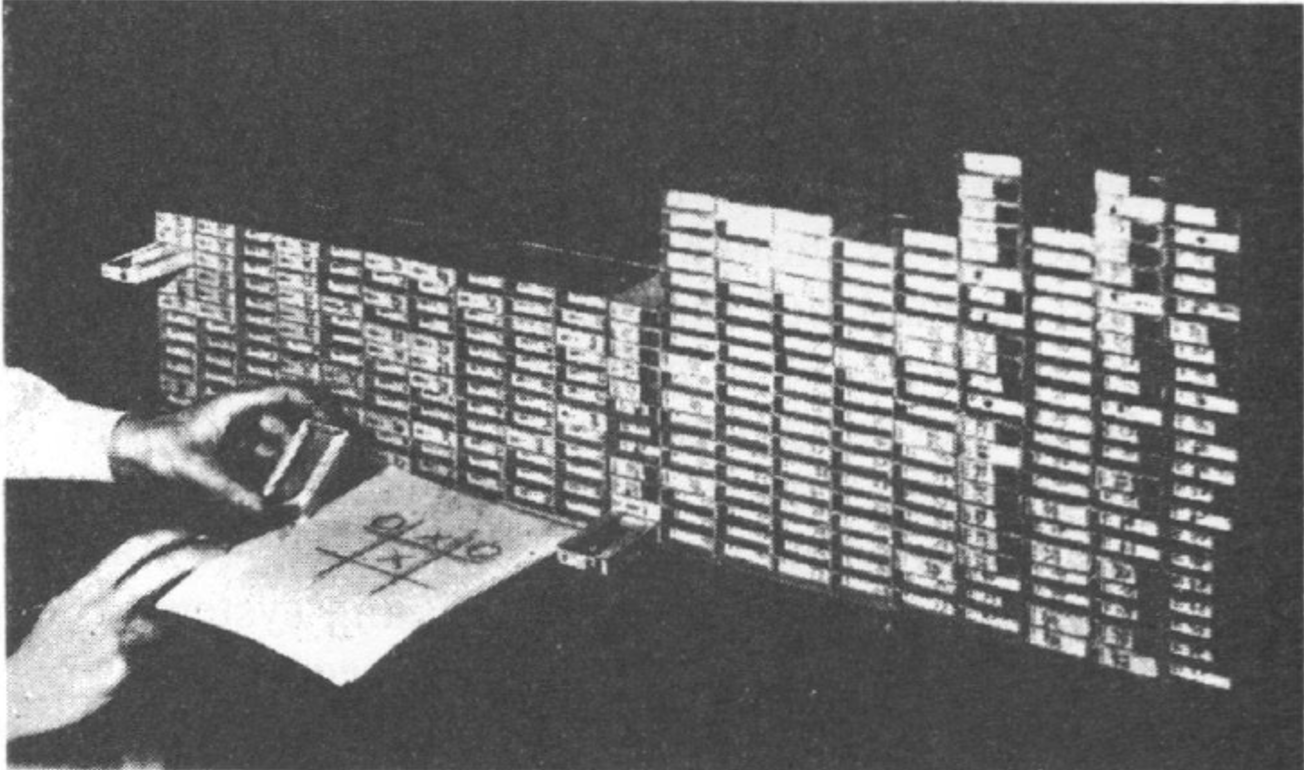
In his early research he did not have access to an electronic computer, so instead he built one out of match boxes (matches for lighting fires and cigarettes were sold in small cardboard boxes that could be slid open or closed). His machine was designed to learn how to play the came of Tic-Tac-Toe (US name), or Noughts and Crosses (British name). Each box represented a particular partially played configuration of the game (there were 304 of them). And contained colored beads, each color representing a a square for the next move. One bead was drawn randomly to determine the machine’s next move. Then right at the end of the game there was a single signal indicating how well the game had been played by the machine: win, lose, or draw. For a loss all the played beads were removed (negative reinforcement) while for a win, more beads of the same color were added to each played box (positive reinforcement).
The machine learned how to play the game through this reinforcement. Back in 2017 I wrote a long post on the exact details of how everything worked.
BTW, back in 2018 I wrote four essays titled Steps Towards Super Intelligence, parts “I: How We Got Here”, “II: Beyond the Turing Test”, “III: Hard Things Today”, and “IV: Things to Work on Now”. I’ve heard the term Super Intelligence is bring thrown around more recently. Looking back at these eight year old essays many things have come to pass that I said we needed back then, language and coding agents in particular, but the improvements I called for in embodied intelligence are only yet at the hype stage.
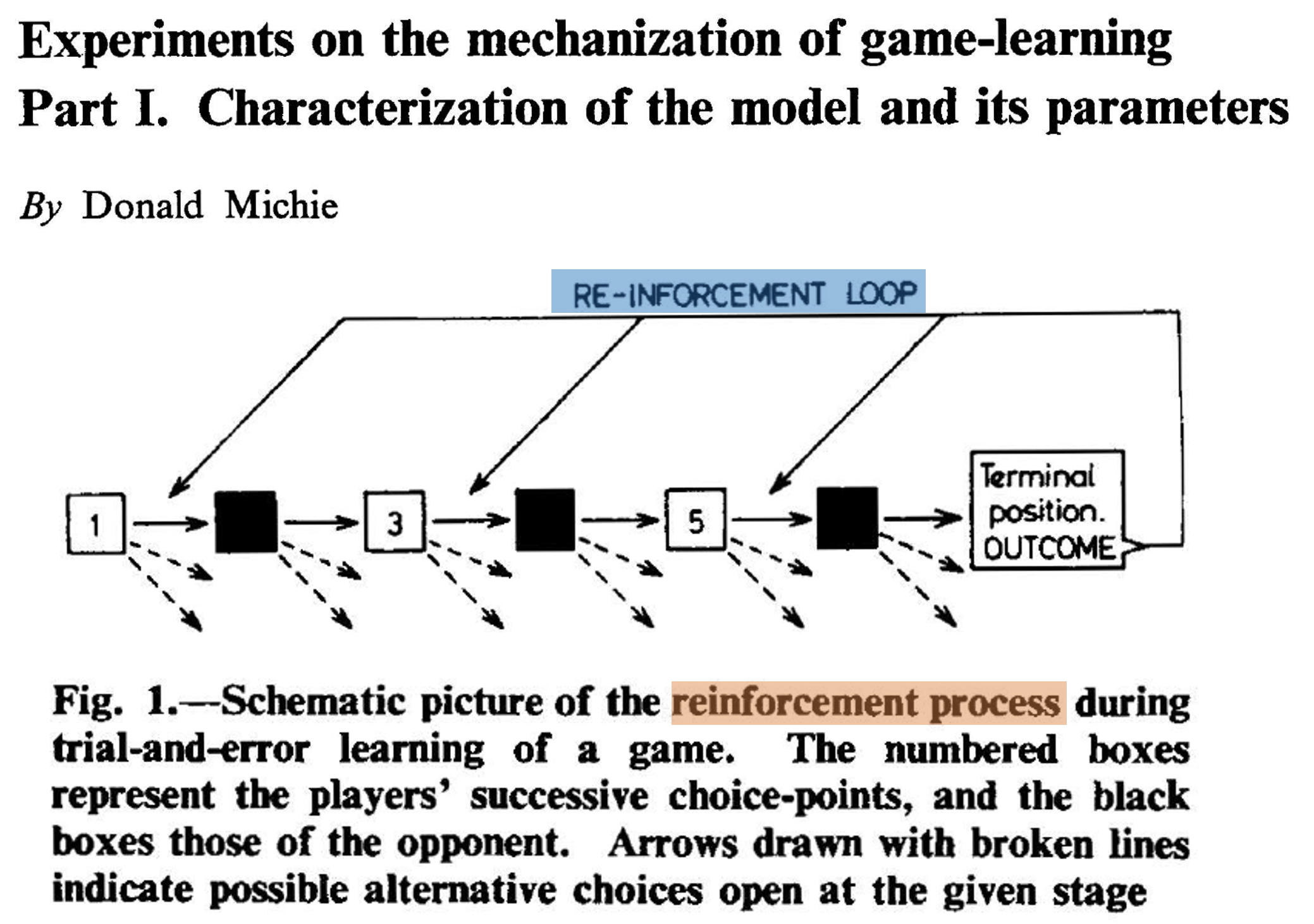
Here is the first part of the 1963 paper by Michie, with my highlights of the use of the word “reinforcement”. The approach is the simplest possible version of modern reinforcement learning, and some mathematically equivalent version of the matchbox machine is usually discussed in the first day of any reinforcement learning class.
And here is a picture of the “machine”.
Modern reinforcement learning has been critical to playing Go, predicting the folding of proteins, and as a harness around Deep Learning (see above) in modern generative AI systems.